
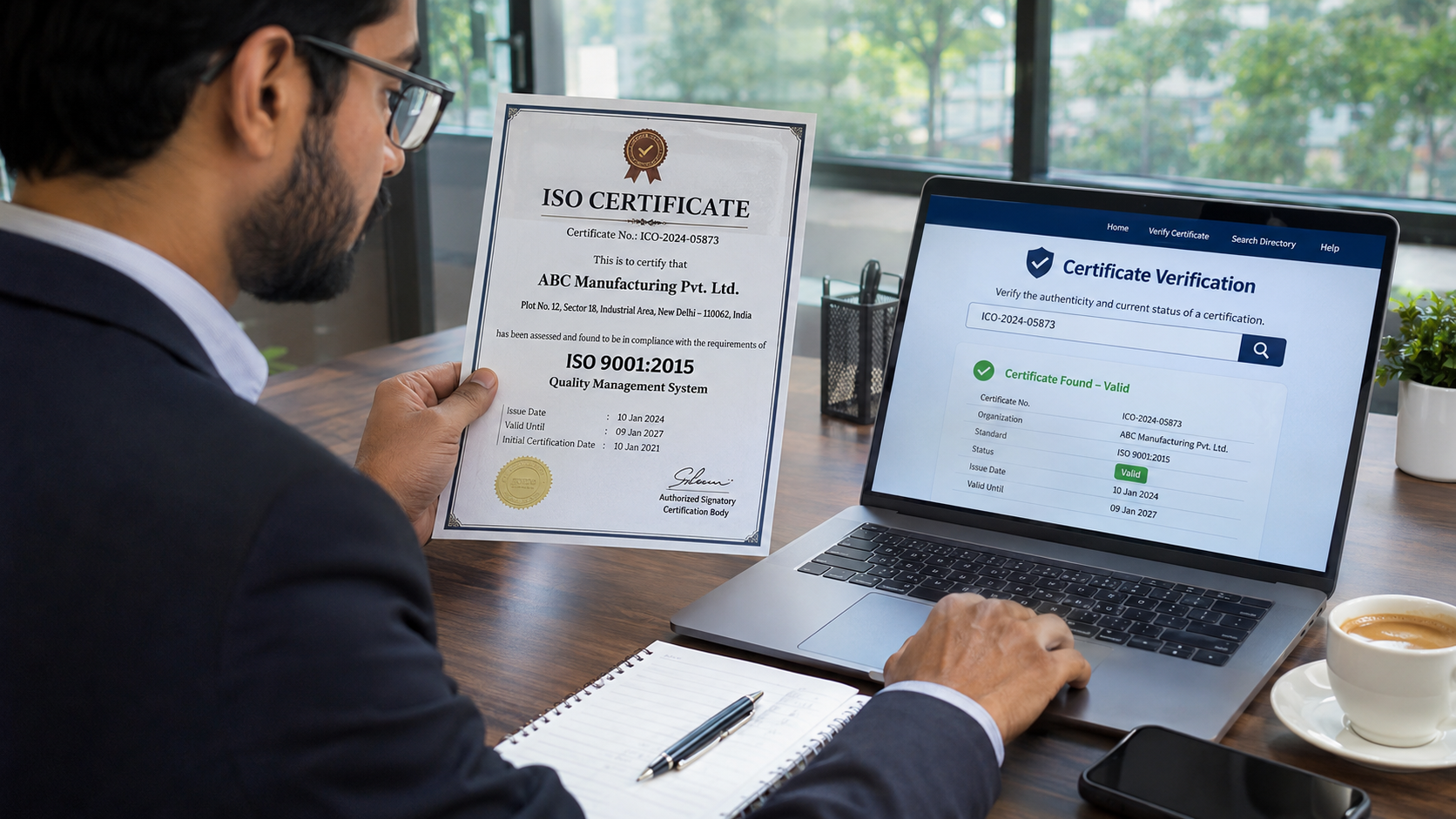
An ISO certificate can help a customer, buyer, regulator, or business partner understand how an organization manages quality, environmental responsibilities, occupational health and safety, information security, or other defined activities. But a certificate image, supplier brochure, or website badge is not enough to establish that a certification is genuine, current, and relevant to the work being purchased.
To verify an ISO certificate online, check the certified organization's legal identity, the exact standard and scope, the certification body's identity, the certificate's current status, and—where accreditation is claimed—the certification body's accreditation. Compare records with the issuing certification body and, for accredited management system certificates, an appropriate recognized verification source. Keep a record of what you checked and when.
This guide explains that process in practical language. It is intended for procurement teams, tender evaluators, quality managers, auditors, and organizations that want to explain their certification claims accurately. It also shows how Global ISO Register can support research into certification bodies, accreditation bodies, and standards without replacing confirmation from the organizations responsible for issuing and accrediting certificates.
What Does ISO Certificate Verification Mean?
ISO certificate verification is the process of checking whether a particular certificate was issued to the named organization, covers the activity or location claimed, and remains valid according to the issuing certification body. If the certificate is presented as accredited, verification also involves confirming that the issuer had accreditation for the relevant certification activity.
The distinction matters because a certificate may be genuine but irrelevant to the purchase you are considering. For example, a manufacturing group could hold a quality management system certificate for its headquarters while a different factory, process, or legal company remains outside the certified scope.
A robust verification therefore asks three questions:
Is the document genuine?
Is the certification currently effective?
Does its scope cover the organization, site, product, service, or process relevant to the decision?
These questions are related, but they are not interchangeable.
A search result is evidence to consider, not a substitute for interpreting certificate details. It should be supported by the issuing body's current records whenever material business, legal, or contractual decisions depend on it.
Understand ISO, Certification Bodies, Accreditation Bodies, and Registers
Before starting an online ISO certification check, it helps to understand who performs each role. Incorrect assumptions at this stage can lead to mistaken acceptance of unsupported claims or unfair rejection of legitimate suppliers.
ISO Develops Standards; It Does Not Issue ISO Certificates
The International Organization for Standardization (ISO) develops and publishes standards. Certification to applicable standards is carried out by independent certification bodies, not ISO itself.
An organization should not claim that "ISO certified us" when it means that an independent certification body audited and certified its management system. ISO also restricts the use of its own logo in connection with certification claims.
This difference is explained on the official ISO certification information page. When you assess a certificate, identify the actual issuing certification body rather than treating a reference to ISO as proof of issuer status.
Certification Bodies Issue Certificates Within a Defined Scope
A certification body evaluates conformity against the relevant standard or certification scheme.
For management systems, the assessment generally examines how the organization has established, implemented, maintained, and improved its system within its declared scope.
The certification body determines certification decisions and maintains records of certifications it has granted, suspended, withdrawn, or otherwise changed.
Its name, contact details, and certification register are important primary sources.
Global ISO Register also provides a directory of certification bodies that can help researchers identify organizations and follow up on their details.
A directory listing alone does not establish that every certificate issued by a listed body is accredited or currently valid.
Accreditation Bodies Assess Certification Bodies
Accreditation is a separate form of independent recognition.
An accreditation body assesses a conformity assessment body against applicable requirements and recognizes its competence for particular activities.
For management system certification, the scope of the certification body's accreditation is especially important: accreditation for one activity or standard does not automatically cover all others.
Global ISO Register maintains an accreditation bodies directory for research and contact discovery.
To verify an accreditation claim, review the accreditation body's own current records, its scope, and any relevant international recognition arrangements.
Online Directories Are Useful, but Their Roles Differ
Different websites may publish company records, certification-body profiles, accreditation-body directories, or verified accredited certification datasets.
They may use different data sources and update schedules. That is why a missing entry in one directory is not automatically proof that a certificate is fake.
Global ISO Register describes its purpose as helping users search certification information and learn about certification and accreditation bodies.
The platform is distinct from ISO itself and should not be presented as the official issuer of ISO certificates.
What Information Should a Genuine ISO Certificate Contain?
Start with the actual certificate, preferably an original electronic copy supplied by the certified organization.
Avoid relying solely on a cropped screenshot, decorative badge, or a paragraph in a company profile.
Certificates differ between certification schemes and issuers, but a useful initial check covers the following information:
Certified organization: The full legal or registered name, with any relevant trading name clearly understood.
Address or covered locations: The site or sites included in the certification, where specified.
Standard and edition: Such as ISO 9001, ISO 14001, ISO 45001, or ISO/IEC 27001, together with the edition shown on the certificate.
Scope statement: The management system, products, services, processes, and organizational activities covered by the certification.
Certificate identifier: A unique reference or number that can be quoted during verification.
Certification body: The entity that made the certification decision and issued the document.
Relevant dates: Initial certification, issue, reissue, expiry, or recertification dates, as applicable.
Accreditation information: Any accreditation mark, reference, or statement, if accredited certification is being claimed.
Site or appendix details: A schedule that may list multiple branches, sites, or specific activities.
Some certificates use digital verification links or QR codes.
Treat those as convenience features, not proof in isolation. Check that the destination belongs to the legitimate issuing body and that the live record matches the certificate.
A convincing design or valid-looking QR code can still direct a buyer to an unofficial website.
How to Verify an ISO Certificate Online: Seven Practical Steps
The following workflow is suitable for most business-to-business checks. The depth of investigation should match the risk of the purchase, the certification claim, and the requirements of the buyer or regulator.
Step 1: Obtain the Certificate and Record the Exact Details
Ask the supplier for its current certificate, including any scope annex or site schedule.
Record the legal name, certificate number, standard, scope, certification body, dates, and site address.
Preserve the document as originally received rather than editing it or relying on an informal transcription.
Compare the name with the supplier contract, purchase order, company registration, and invoice details.
A small spelling variation may be harmless, especially where translations or registered trading names are involved, but it should be resolved rather than ignored.
If the business operates through subsidiaries, identify which legal entity is certified.
Step 2: Identify the Issuing Certification Body
Locate the issuer's complete name on the document.
Visit its own website or find its published contact information using a trusted source.
You may use the Global ISO Register Certification Body Directory as an initial research aid, but independently check the issuer's official contact details before sharing sensitive documents or relying on an unfamiliar link.
Do not assume that the company selling certification services and the company issuing the certificate are always the same legal entity.
Some organizations use regional offices, brands, or agents. Where the structure is unclear, ask the issuing body to confirm the responsible legal entity.
Step 3: Search the Certification Body's Register or Contact It Directly
If the certification body publishes a certificate search or client directory, enter the certificate number or certified organization's name.
Match the displayed information against the actual certificate.
If the register does not provide the necessary detail, contact the issuer through independently verified official channels.
Useful questions include:
Was this certificate issued by your organization?
Is it currently valid or active?
Is any suspension, reduction, or withdrawal in effect?
Which sites and activities are within its scope?
Is the stated standard and edition accurate?
Where relevant, was the certification issued under your accreditation?
A successful contact is not simply receiving an email that says "confirmed."
Preserve the date, sender, certificate reference, and substance of the confirmation so your organization can demonstrate how it reached its decision.
Step 4: Check an Appropriate Accredited Certification Database
For accredited management system certificates, check IAF CertSearch or the current official service it directs you to.
ISO identifies CertSearch as a means of verifying accredited certificates using information from certification and accreditation bodies.
Search using the organization name, certificate number, and suitable location details, where supported.
Compare the listed certificate, issuing body, standard, and status.
Keep in mind that databases vary in coverage and synchronization; investigate differences rather than guessing.
A positive database match is helpful evidence. It does not remove the need to check the scope, legal entity, and contractual relevance of the certified activities.
Step 5: Verify Accreditation and Its Relevant Scope
If a supplier advertises "accredited ISO certification," examine which accreditation body is named and whether the certification body was accredited for the relevant standard, scheme, and time period.
Use the accreditation body's current official directory or contact it directly.
Accreditation is not a universal label covering every service that an organization offers.
Ask whether the accreditation scope covers management system certification for the standard concerned.
When a certificate includes an accreditation symbol, check that the symbol is used appropriately and that the issuing certification body and accreditation entity match.
A directory of accreditation bodies can help identify the institution; it cannot substitute for verification of the accrediting institution's current records.
Accreditation is not compulsory for every legitimate certification activity.
Non-accredited certification is not automatically fraudulent, but it must not be described as accredited, and a procurement rule may explicitly require accredited certification.
Step 6: Match the Scope and Locations to Your Purchasing Requirement
Read the scope statement carefully.
"Provision of consulting services" is different from "manufacture and supply of medical devices."
A certificate for one branch may not cover the warehouse or production site delivering the goods.
Likewise, holding a quality management certification does not mean every product is individually certified or legally approved.
For multi-site organizations, request the appendix identifying the covered sites.
For outsourced processes, confirm whether the management system and certification scope actually address the activities relevant to your contract.
If your tender requires a particular standard for a defined service, document how the scope supports that requirement.
Where interpretation is unclear, ask the certification body for clarification before accepting or rejecting the document.
Step 7: Record the Conclusion and Set a Future Review Date
Finish the check with a short evidence record.
It should state the exact certificate reviewed, the sources consulted, the date of checking, the status returned, and any unresolved discrepancies.
Classify the outcome as:
Verified for the required purpose.
Pending clarification.
Not verified from available evidence.
Invalid based on authoritative confirmation.
Schedule a new check when a relevant event occurs: a contract renewal, an approaching certificate expiry, a major scope change, the supplier moving to another location, or a report of suspension or withdrawal.
Verification is a point-in-time conclusion, not a permanent guarantee.
ISO Certification Validity: Active, Suspended, Withdrawn, and Expired
The word "valid" can hide several different states.
A certificate may still display a future expiry date while the issuing body has suspended its effectiveness.
It may have been withdrawn entirely, reissued after a change in scope, or superseded by a newer certificate number.
Active certification generally means the issuer currently recognizes the certification for the stated scope.
Suspension means the certification is temporarily subject to an adverse status, often with restrictions on the holder's certification claims.
Withdrawal means certification is no longer maintained under the certificate.
Expiry means the validity period shown has ended unless a valid renewal or replacement is confirmed.
Specific status terminology depends on the scheme and issuer.
A printed certificate is therefore historical evidence of a certification decision, not necessarily a real-time status record.
Do not infer current validity from the expiry date alone. Ask the issuer for the effective status at the date your organization needs to rely on the certification.
If a certificate has been reissued, compare both versions.
Check whether the change is administrative, such as a new company name, or substantive, such as reduced scope or removal of a site.
Keep only the current version in the active supplier qualification file while retaining earlier versions as audit history when required by your retention rules.
Why Certificate Scope Matters More Than a Logo
An ISO certificate does not automatically certify every product, professional, building, or process associated with the organization.
A management system certificate describes a defined organizational management system and its activities.
Product certification, inspection, personnel certification, and testing laboratory accreditation involve different conformity assessment frameworks.
For example, a supplier may advertise ISO 9001 in a brochure while your contract concerns a highly specialized medical device or laboratory measurement.
ISO 9001 certification can be relevant evidence about quality management, but you may also need product approvals, specific testing evidence, or a different sector standard.
Those requirements should be assessed on their own merits.
Treat the scope statement as the core of your verification exercise.
It should be broad enough to include the work you are buying but specific enough to establish what was assessed.
If the wording is unclear, avoid translating broad marketing language into a stronger technical assurance than the certificate supports.
Multi-Site and Group Certifications
A group may operate under one brand while its members are separate companies.
It may have a certificate covering several sites, a centrally controlled management system, or individual certificates for each legal entity.
The applicable sites should be clearly stated in the certificate or associated schedule.
Do not presume that a branch is covered merely because it uses the same logo, email domain, or corporate headquarters.
Where the delivered goods come from a factory not listed in the certificate's schedule, request clarification and evidence explaining the certified arrangement.
How to Check Accreditation Without Confusing Recognition and Scope
Accreditation is often described as assurance of the certification body's competence.
That is broadly useful, but an accurate check requires more precision.
An accreditation body accredits defined activities within a specific scope.
Its recognition arrangements, geographic location, and the applicable conformity assessment standard may all matter for acceptance by a buyer or regulator.
For management system certification, ISO/IEC 17021-1 is a key standard associated with certification body requirements.
Other conformity assessment activities use different standards.
A laboratory's accreditation under ISO/IEC 17025, for example, is not proof that it may issue accredited ISO 9001 management system certificates.
The Global ISO Register Accreditation Directory and ISO Standards information help visitors distinguish the organizations and standards involved.
To confirm current recognition and scope, always consult the accrediting organization's published records or obtain direct confirmation.
For a cross-border purchase, ask whether the recipient, customer, or tender authority accepts that particular accreditation arrangement.
An accredited certificate may be broadly recognized, but acceptance is ultimately governed by the applicable contract, scheme, tender, or regulation.
Verification Considerations for Common ISO Management System Standards
Different standards address different organizational risks.
Verification should not stop at recognizing a familiar number.
Check the exact standard, applicable edition, scope, and any certification-scheme requirements relevant to the purchase.
ISO 9001: Quality Management Systems
ISO 9001 is used to assess quality management systems.
In supplier evaluation, it may support confidence that the organization has established processes for meeting customer and applicable requirements and improving its operations.
It is not a blanket guarantee that each delivered item is defect-free.
For an ISO 9001 certificate, verify the supplier's legal name, certified activities, production or service sites, issuer, accreditation claim, and current status.
Procurement teams should still perform appropriate product, technical, financial, and contractual due diligence.
ISO 14001: Environmental Management Systems
ISO 14001 concerns environmental management.
Its certification should be evaluated against the activities, facilities, and environmental aspects included in the stated scope.
Do not infer a particular emissions reduction, carbon-neutral status, or environmental product label merely from an ISO 14001 certificate.
If a purchaser needs evidence about a specific environmental outcome, request the supporting data, permits, reports, or product declarations separately.
The management system certification and the specific environmental claim answer different questions.
ISO 45001: Occupational Health and Safety Management Systems
ISO 45001 addresses occupational health and safety management.
A contractor may use it to demonstrate a structured approach to managing workplace health and safety risks.
However, certification does not prove that an organization has had no incidents or that every workplace risk has been eliminated.
Check that the certified organization and work locations match the contractor's proposed activities.
Follow up with required training, competence, insurance, incident history, and local legal-compliance evidence where relevant.
ISO/IEC 27001: Information Security Management Systems
ISO/IEC 27001 certification relates to an information security management system.
Its scope may be limited to particular business functions, facilities, services, or information-processing activities.
This is especially important when selecting cloud, technology, outsourcing, or data-processing suppliers.
Verify whether the service or business unit handling your information is included.
Certification can form one part of security assurance, but contracts, technical assessments, data protection obligations, and ongoing control monitoring remain necessary.
ISO 22000, ISO 13485, and Specialist Schemes
Food safety management, medical devices, and other specialist fields have additional technical, regulatory, and scheme-specific considerations.
ISO 22000 and ISO 13485 certification may be relevant, but they should not be confused with product approval or regulatory market authorization.
Check whether the certificate is appropriate to the exact sector and jurisdiction.
Not every international standard is intended as the basis for accredited third-party management system certification; some standards provide guidance rather than certifiable requirements.
If a website lists a standard, that alone does not demonstrate an accredited certification pathway for it.
How Procurement Teams Can Use ISO Certificates Responsibly
Procurement teams often collect dozens or hundreds of supplier certificates.
Without a consistent review process, checks become inconsistent and records quickly become outdated.
A simple qualification procedure makes the outcome more reliable and easier to audit.
First, classify the business risk. A low-risk office supplier may require a basic status and scope check. A critical manufacturer, hospital contractor, food supplier, data processor, or safety-sensitive service provider may warrant formal confirmation from the issuer, additional technical evidence, and a periodic monitoring plan.
Second, define the acceptance criterion before reviewing candidates. Does the tender require certification to a particular standard? Must the certification be accredited? Which activities and sites must be covered? Is a recognized certification scheme mandatory?
Third, apply the same evidence standard to competing suppliers. Record the status and source of each verification, and provide a fair opportunity to resolve administrative differences such as recent company-name changes or certificates awaiting database synchronization.
Fourth, require re-verification after meaningful changes. Certification status, business structures, and operational scopes can change. The certificate should be treated as controlled supplier evidence, not as a document that is collected once and forgotten.
A Reusable ISO Certificate Verification Checklist
The following checklist can be added to a supplier qualification file, audit procedure, or tender evaluation form.
Mark each item as confirmed, not applicable, or pending further evidence rather than assuming every blank is a failure.
| Checkpoint | What to confirm | Useful evidence |
|---|---|---|
| Identity | Legal name and relevant trading name match the supplier | Company registration and certificate |
| Standard | Standard, edition and scheme meet the requirement | Certificate and tender specification |
| Scope | Certified activities cover the purchased service or product context | Scope statement and annex |
| Site | Relevant factory, branch or service location is included | Multi-site schedule or issuer confirmation |
| Issuer | Named certification body is genuine | Issuer's official register or direct response |
| Current status | Certificate is active for the required date | Current issuer record or verification result |
| Accreditation | Claimed accreditation covers the relevant activity | Accreditor's official scope directory |
| Record | Verification date, sources and reviewer are recorded | Supplier qualification log |
For a simple purchase, several checks can be completed together.
For a high-consequence contract, assign responsibility for resolving exceptions and retaining supporting correspondence.
A checklist improves consistency, but it does not replace professional judgment.
What If an ISO Certificate Cannot Be Found Online?
A missing search result is a reason to investigate, not a final finding of fraud.
The company may use a different legal name, a certificate may have been reissued, the search database may not include that issuer, or an update may be pending.
There could also be a genuine problem with the document or its current status.
Start by checking spelling, punctuation, subsidiaries, country, and certificate number.
Search the official issuer's register where available, and ask the supplier for the latest document with the full scope annex.
If you still cannot establish the record, contact the certification body directly using independently verified contact information.
If the supplier cannot identify the issuing body, refuses reasonable verification requests, or provides inconsistent certificate details, escalate the case according to your due-diligence procedure.
Document the discrepancy without making unsupported accusations.
Only a suitable authoritative source should be used to state definitively that a particular certificate was never issued or has been withdrawn.
A useful final status is "not verified from available evidence."
It accurately describes a gap without treating absence from a third-party directory as proof that the underlying certification is invalid.
Warning Signs That Deserve Closer Examination
No single visual characteristic proves a certificate is counterfeit, but several recurring warning signs justify further checking.
They include an issuer whose official identity cannot be established, a certificate number that the named issuer does not recognize, conflicting organization names, a vague scope that does not match the advertised activity, and accreditation claims that cannot be supported by the relevant accreditation body.
Be cautious with logos and seals.
A certificate containing ISO branding is not more credible simply because the document looks formal.
ISO itself does not issue certificates, and misuse of marks can occur.
Check every important claim against a source with responsibility for that claim.
Another warning sign is pressure to accept a document immediately without independent checks.
A legitimate supplier should ordinarily be able to identify the issuing certification body and cooperate with reasonable verification.
Some documents may contain commercially sensitive information, so an appropriate direct confirmation or redacted supporting record may be preferable to unnecessary disclosure.
Most importantly, distinguish an unverified claim from a proven false claim.
Fair, evidence-based wording protects both the buyer and suppliers from avoidable misunderstanding.
International ISO Certification Verification and Cross-Border Suppliers
Global supply chains create additional verification challenges.
Organizations may use different legal naming conventions, certificates may be issued through regional offices, and accredited certification may be recognized under arrangements that are unfamiliar to a procurement team in another country.
Do not treat the country printed on a certificate as the only relevant factor.
Review the legal identity of the holder, the applicable certification body, the accreditation body, and the declared certification scope.
If a contract demands a particular recognition arrangement, evaluate that requirement explicitly rather than assuming a foreign certificate is automatically acceptable or unacceptable.
For multinational groups, request a complete schedule of sites, particularly when production, design, service delivery, and administrative functions operate in separate countries.
For remote services, examine whether the management system scope includes the service delivered to your organization.
The purpose of verification is not to prefer local or foreign certificates.
It is to establish that the evidence is authentic, relevant, and acceptable under the applicable purchasing or regulatory requirement.
How Certified Organizations Can Make Verification Easier
Organizations holding legitimate certificates can reduce buyer friction by maintaining a clear certification information page.
Publish the legal name of the certified entity, the standard, a truthful scope summary, the issuing certification body's name, and—when appropriate—the certificate number and a link to the issuer's official verification service.
Avoid broad claims such as "all our products are ISO approved" when the certificate covers only a management system.
Ensure that website badges, tenders, proposals, and social media profiles use the correct certified company name and do not misrepresent the role of ISO or the scope of accreditation.
When a certificate is renewed, suspended, transferred, or reduced in scope, update public claims promptly.
Provide procurement teams with the current certificate and any site annex.
Where direct public lookup is limited, explain how interested parties can seek confirmation from the certification body.
Finally, treat certification information as maintained business content.
Assign someone to track key dates, retain issuer correspondence, and review marketing language.
Clear presentation makes the supplier easier to evaluate without stretching what certification actually means.
How Certification Bodies Can Support Transparent Records
Certification bodies help the market when their current certificate records are understandable and accessible.
A reliable public register or responsive verification desk should enable an authorized enquirer to establish the certificate holder, the relevant standard, the certification status, and enough scope information to determine relevance, subject to privacy and applicable scheme rules.
Certification bodies should also communicate changes that affect reliance on certification, including suspensions, withdrawals, and scope changes, through their established processes.
Maintaining consistent names and identifiers across certificate documents, verification systems, and accreditation records reduces unnecessary disputes.
Global ISO Register offers information about certification bodies and a route for organizations to submit certification body details for review.
Its Certification Body Information Form indicates that submitted information is intended to be sent for authentication or approval.
Such directory participation may improve discoverability, but it should not be confused with an accreditation decision or a certificate's primary verification record.
Where Global ISO Register Fits Into the Verification Process
Global ISO Register presents itself as a resource for searching ISO certification information and understanding the organizations involved in conformity assessment.
Its public website includes separate directories for Certification Bodies and Accreditation Bodies, together with a section describing ISO Standards.
These resources can help a buyer identify a named body, understand terminology, and decide which organization to contact next.
They can also help a certified business or conformity assessment body see how its public information is presented.
When the decision requires authoritative confirmation of status or accreditation, go back to the issuing body, accrediting body, or appropriate accredited certification service.
The site's About page describes a mission of supporting access to certification information and transparency.
That mission aligns with careful verification, but a responsible article should not imply that merely appearing in a directory proves current accreditation or certificate validity.
The same principle applies to any other third-party information service.
How to Handle Conflicting Information From Multiple Sources
Occasionally, the supplier's PDF, a certification body's public register, an accreditation directory, and a third-party listing do not agree.
The correct response is to identify precisely what differs.
A name mismatch may arise from a merger, a change of registered address, or a translation.
A validity mismatch may relate to a renewal, suspension, database delay, or an obsolete copy.
Prioritize primary evidence for the claim under investigation.
The issuing certification body is responsible for its certification decisions and current certificate status.
The accreditation body is responsible for its accreditation decisions and scope.
Company registries can clarify the identity of a legal entity, while contracts explain what the buyer actually requires.
Record conflicting records and ask a focused question.
Instead of "Is this company certified?", ask "Was certificate ABC-123 active on the contract award date, and does its scope cover the named manufacturing site?"
A specific question is easier to verify and produces a more useful audit trail.
If the discrepancy remains unresolved, hold the decision or apply the organization's documented exception process.
Do not silently select the most favorable search result.
Building an Ongoing ISO Certificate Monitoring Process
For an organization managing many suppliers, a repeatable process is more valuable than sporadic searches.
Maintain a controlled register containing the supplier's legal name, certificate number, standard, issuer, scope summary, relevant sites, expiry date, verification source, last checked date, result, and next review date.
Set review triggers based on business risk.
They may include an approaching expiry date, contract renewal, a new facility, a material change in supplied services, an announced acquisition, or notice that certification status has changed.
Decide who owns the review, how exceptions are handled, and which evidence must be retained.
For critical suppliers, a periodic direct check or an authorized monitoring service may be appropriate.
For lower-risk suppliers, verification at onboarding and defined renewal events may suffice.
There is no single interval suitable for every sector, regulation, or contract.
This kind of controlled record helps procurement, legal, quality, security, and operations teams share one evidence base.
It also prevents repeated requests for the same certificate while making status changes visible before they affect an important purchasing decision.
An Example of a Defensible Verification Decision
Suppose a construction contractor provides an ISO 9001 certificate to qualify for a new project.
The document has a valid-looking certificate number and an expiry date next year.
The procurement officer checks the issuer's current client directory and confirms that the certificate is active.
However, its scope refers only to design consultancy, while the contractor is bidding to carry out site installation work.
The correct conclusion is not that the certificate is fake.
Its authenticity and active status may be supported by the issuer's records.
The issue is whether the certified scope satisfies the tender condition.
The reviewer should request clarification, the complete scope appendix, or additional evidence before deciding.
Now consider a different case: a supplier provides a certificate that names a certification body, but that body confirms the number was never issued by it.
This is materially different from a missing directory search result.
The procurement team should document the primary-source response, follow its escalation procedure, and avoid treating the unsupported document as satisfactory evidence.
Both examples illustrate why certificate verification is a structured decision, not a simple green or red badge.
Conclusion: Verify the Issuer, Status, Accreditation Claim, and Scope
The most reliable way to check an ISO certificate is to start with the document, identify the issuing certification body, verify current status through suitable primary sources, examine any accreditation claim, and confirm that the certified activities and sites meet your actual requirement.
Retain evidence and revisit the check when important circumstances change.
Online directories can make the research faster.
Global ISO Register provides reference information about certification bodies, accreditation bodies, and standards, while authoritative confirmation should come from the organizations responsible for the relevant certification and accreditation records.
A careful verification process protects buyers from unsupported claims and gives genuinely certified organizations a clearer way to demonstrate what their certification covers.
For more information about the organizations involved, explore the Certification Bodies Directory, Accreditation Bodies Directory, and ISO Standards pages, or contact Global ISO Register with a question about its directory information.

